| |
DULWICH London
All Saints
[Note: These are my observations of the building, as originally written,
complete with reference to illustrations, prepared prior to the fire of 2000
which so severely damaged the building.]
This building was George Fellowes Prynne’s first major project in the London
area. It was built between 1888 and 1892, shortly after Fellowes Prynne finished
his work to complete the west end of St. Peter’s Church, Streatham, located only
a few miles away. It was probably his most ambitious design, save that of
Colombo Cathedral, but it was never completed to his full plans. From various
contemporary documents, recent writings and personal observation, the design
features of this fascinating building can be described.
“No-one who has passed Dulwich Station on the Chatham and Dover Railway
can have failed to notice the remarkable church which stands on an eminence some
little distance from the line. This is All Saints’…”
So began an article in Church Bells (5 March 1897) in which an
interview with the first incumbent, the Rev. James Beeby, is recorded. It was
this man who was the motivating force behind the building of All Saints’ in the
first place. It seems that he was not greatly fond of small churches, which goes
some way to explaining why he wanted the new church to be able to hold 1600
worshippers when complete. He was thinking ahead to the growth of the area,
already triggered by the railway, and doubtless assumed that congregations would
increase in the same proportion.
Any description of the church will struggle to convey the massive
proportions and sense of space and height of the building, despite that
description’s providing full factual details of the dimensions. The following,
therefore, is given with the intention of attempting to convey as much as
possible, but, like all the great buildings, it is no substitute for actually
seeing it for yourself.
The site on which the church is built is triangular, and drops from west to
east about 28 feet. This drop allows for the construction of a spacious crypt
beneath the chancel and sanctuary. The nave is 68 feet high, 40 feet wide, and
would have been 128 feet in length if completed. The chancel is the same height
as the nave, and is in the form of a lofty pentagonal apse at the east end,
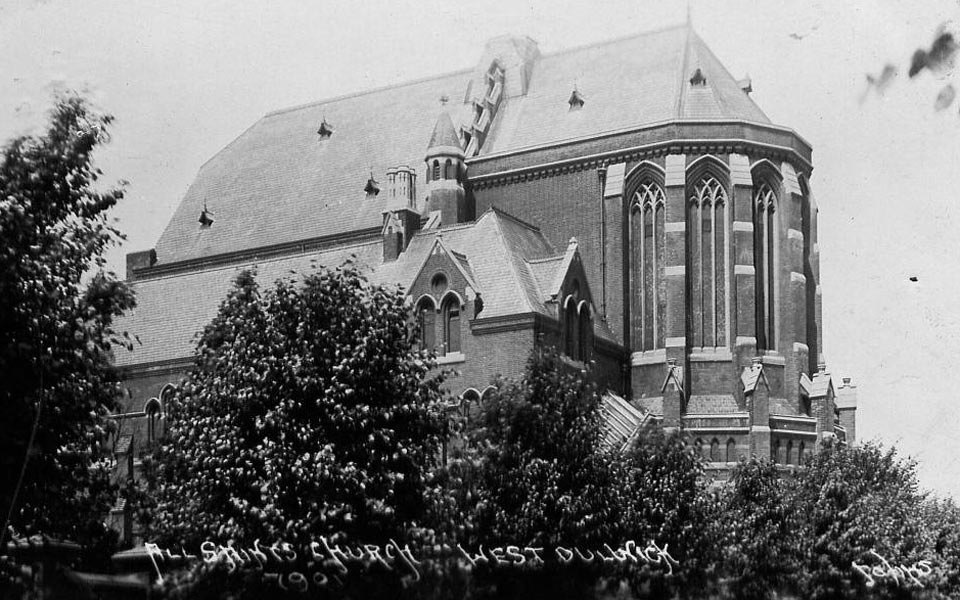
reminiscent very much of French cathedral design. See the illustration of an
early postcard.
The original plan for the interior had seven double-arched bays, with the
piers being built of brick and stone. Only four bays were built. There are
panels above each of the lower arches, which were probably designed to be filled
with murals, and a clerestory in the upper level of arcading, consisting of
groups of triple lancet windows. See illustration of the architect's design for
the interior. Between each group of windows is a groined vault, which supports a
barrel roof. Unusually, this roof is slightly pointed at the apex, rather than
being round like the traditional wagon roofs of Devon.
The chancel and nave are separated by a lofty arch, in which is rich stone
tracery – the first of Fellowes Prynne's stone screens. This tracery is high up,
and fills the curve of the arch. Lower down is a wrought iron rood screen, set
between the pillars which spring from a chancel wall, and support the
stone screen. The
chancel wall has wrought ironwork upon it, and there are wrought iron gates at
the entrance to the chancel. Arches to the south of the chancel divide it from
the vestries and support the organ chamber; to the north a musicians’ gallery is
located above the arch dividing the chancel from the Lady chapel. The spaces
between these arches and associated pillars are filled with wrought iron
screens. There is an ambulatory running behind the arches south and north
connecting the Lady chapel with the vestries and access to the crypt. It gives
passage behind the high altar, tracing the rounded shape of the massive apsidal
sanctuary.
This sanctuary must be the most imposing Fellowes Prynne ever designed and
saw completed. The high altar is raised upon seven steps, and is
“…a masterpiece of carving, 12 feet in length…..executed from the
architect’s design by Mr. Peter Cook of Kennington and… decorated by Messrs.
Clayton and Bell.” (Church Times issue unknown 1891)

These
days this altar is covered by its frontal, but it is in fact typical of Fellowes
Prynne’s designs for altars, consisting of three open panels through which the
appropriate altar frontal for the season would show. Behind the altar are simple
dossal curtains, in front of which can be appreciated the fine altar
candlesticks and cross. The photo – not the best, but all I now have –
shows the sanctuary flooded in natural light from the east windows. Also
shown is the magnificent altar cross. To either side of the curtains are a series of blind
arcades. These are the frames for stone carvings of sixteen saints, which are
these days highlighted by having been skilfully painted. Four of these are
illustrated above. Whether to paint them was ever Fellowes Prynne’s intention is
not known by the author, but it must be borne in mind that he was fond of
colour, and used brightly coloured murals, paintings and mosaic tiles in many of
his churches. Each saint is named, and carries a representation of the
instrument of his martyrdom. Above the saints and the dossal curtain rises the
magnificent set of seven triple-lighted windows. These do not contain stained
glass – the present glass is the replacement of what was lost after damage
during World War Two. The immediate effect of this huge area of clear glass is
one of immense light. Again, this may not have been the architect’s original
intention, but there is no doubting its stunning effect.
 The
north and south aisles form the body of a chapel on either side. That on the
north side is Lady chapel with an apsidal sanctuary. It reflects the design of
the great sanctuary, in that there is an ambulatory around the back of the
altar, and a series of three windows above it, illuminating this beautifully
proportioned chapel. The ceiling is vaulted in wood, with decorated ribs picking
out the dome above the apse. Pillars leading up to the roof groins rest on
corbels decorated with carved angels holding shields – illustrated left. In
the ambulatory can be seen some of the church’s oldest stained glass windows,
one of which (St Monica) is illustrated right. These are hidden by a
curtain behind the altar, and cannot therefore be seen from the seats. The
chapel has a sense of intimacy about it, when compared to the massive space of
the nave of the church, and it is possibly a surprise to know that around 200
people can be accommodated in it. As well as being a chapel, the seating area of
the north aisle is also part of the main area of the church, as neither it nor
the south aisle (the All Souls’ chapel) is separated from the main body of the
church.
It
is interesting to note that at the division between the nave and chancel, at
either side of the chancel wall and screen, there are narrow bays set at 45
degrees in the corners formed between the chancel wall and the north and south
arcades. This can be made out in the architect's drawing. This kind of
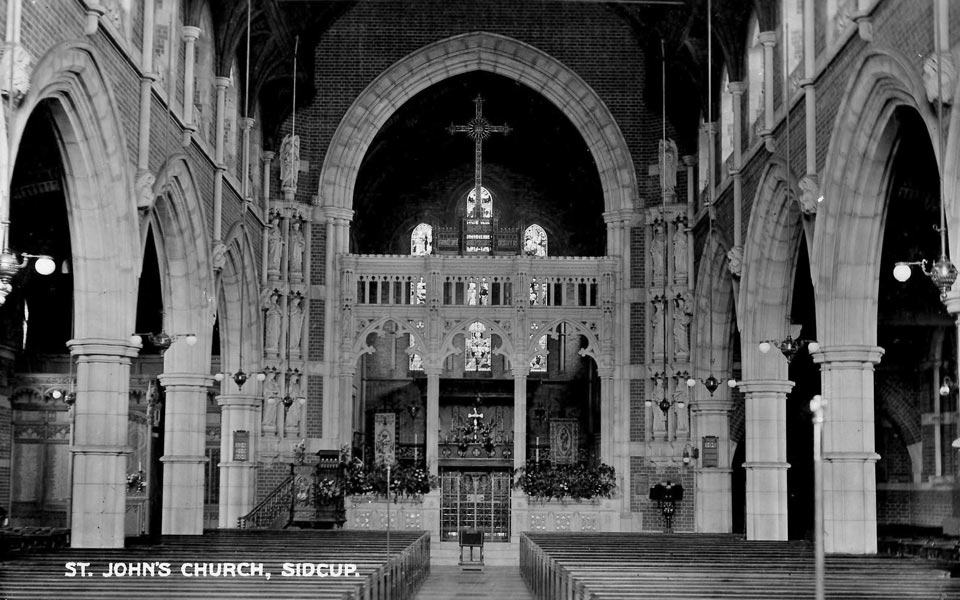
device was used by Fellowes Prynne later in his career at
St. John’s, Sidcup. In the case
of St. John’s, the chancel already existed, and was narrower than Fellowes
Prynne would have wanted; the angled wall helps to draw the eye from the scale
of the nave down to the scale of the chancel. At All Saints, the constraint is
placed on the architect by his use of a massive, undivided nave. The effect of
the angled bays is to bring the worshipper’s attention to the focal point of the
building, namely the sanctuary. The angled bays each have a pair of stacked
arches, the upper arch being a continuation of the musicians’ and organ
galleries, and the lower arch giving access to the ambulatories. The lower arch
on the north side also gives a limited view from the Lady chapel to the main
chancel. The wrought iron pulpit is located next to this northern bay, and is
particularly wide, allowing people seated in the north aisle up to the chancel
of the Lady chapel, to see (and it would be hoped, hear) well. The pulpit is
once again typical of Fellowes Prynne, except that it is in black-finished iron
rather than his more favoured brass. It rests on a stone plinth, embellished
with coloured marble pillars.
The seating in the nave is solely chairs, as was the architect's preference
– see Thurlestone
church – and Fellowes Prynne used his standard arrangement of parquet
flooring for the seating area and coloured encaustic tiles for the aisles. The
marble font is situated at the south end of the centre aisle, a temporary
expedient pending the completion of the building, in particular the designated
baptistery. A lavishly carved font cover, complete with gilded dove, is
suspended above it.
As already mentioned, the site Fellowes Prynne used enabled him to
incorporate a huge crypt beneath the east end of the building. (Another example
of such a scheme is at St. Alban,
Bournemouth.) In the case of All Saints’ church, the existence of the
crypt has a significant effect on the external appearance of the building, as
well as providing space for meetings, children’s groups and other activities.
The external appearance of the building warrants a more detailed
description, as it is unlike anything else Fellowes Prynne was to design. The
first thing that is remarkable about the building when seen from the north-east
or south-east elevations is its immense height. It dominates the area in which
it is situated, partly owing to its elevated site, but more to its scale. The
sense of height is, of course, far greater externally than internally, as the
whole of what appears to be the “ground floor” is in fact the crypt. There are
groups of triple lancet windows along the north and south walls, and a main door
on the south side. Most stunning and worthy of note is Prynne’s use of the apse
at crypt level, for here he has created the effect of buttresses all around,
below the seven sets of east window lights. Each buttress becomes the supporting
structure between each of these windows, and the line is carried all the way up
to the apex of the domed part of the roof above the apse, which is marked by a
delicate metal cross. At ground level, there is an arch between each buttress,
and above these arches, the small lancet windows of the ambulatories of both the
main sanctuary and that of the Lady chapel. There is a walkway at ground level
directly below the ambulatories, beneath the arches formed by the buttresses as
they lean to the building.
To
the south of the apse can be seen a series of lancet windows above a wider
buttress arch. These windows trace the stairway from an entrance to the crypt up
to the main body of the church, and they make a particularly attractive feature
of design. The features to the south elevation are unremarkable: there is a
series of lancet windows at both crypt and main floor level, and on north and
east facing dormers in the roof, but little embellishment elsewhere. The
exception is at the roof rib marking the start of the chancel, at the apex of
which the fleche was intended to be. (A fleche was erected in more recent times,
but was never replaced after collapsing.) At the base of this rib is an
octagonal turret. The old postcard of the exterior shows a squat conical
spire upon this turret, but this is no longer evident. The neighbouring chimney
stack was also twice its present height.
In contrast, the north side of the building is richly decorated. Some of
this dates from the original building, and some to the restoration by J. B. S.
Comper, notably the square bell turret with its pyramidal copper roof,
reflecting somewhat the octagonal feature originally on the south side. Features
on this elevation include the apse of the Lady chapel, and the charming exterior
of a spiral staircase. Comper’s bell turret occupies a space which Fellowes
Prynne had intended for a much smaller and more embellished bell tower, or
campanile; Comper’s structure is arguably more in proportion than Fellowes
Prynne’s would have been, especially given that the church has never been
completed to his original dimensions. The turret was dedicated in 1952 as a War
memorial.
As has been mentioned, the church as designed was never completed. Not only
is it three bays shorter than Fellowes Prynne had planned, but it is missing the
designed apsidal baptistery flanked by two porches. Little has been said of the
west end: there is little to say, as it is rather ugly and not at all in keeping
with either the detail or the spirit of the original design. No doubt there was
always hope that it would only be temporary, but the truth is that the church is
already larger than is needed by the community, and a continual drain on
resources. However, to enter through that uninspiring door makes what greets the
eye all the more exciting – surely one of Fellowes Prynne’s most amazing
achievements.
[Note: The author understands that the plans are to rebuild the East end
of the church along the lines of the original building. The rest will be to a
more modest plan.] |