EALING London
St Saviour
This is the church Fellowes Prynne built, in effect, for himself. It was
demolished in 1940 after having been bombed, but a large memorial crucifix
remains in the vicinity.


From
a postcard of St Saviour's dated 1907 a good deal of detail can be
described. The church had many of what can be regarded as typical Fellowes
Prynne features: red brick contrasting with white stonework, used to distinctive
effect in the nave and at the chancel arch; a stone chancel wall; an elaborate
sanctuary with raised high altar; the use of green wood stained chairs and
attractive electric lighting; the wooden barrel roof giving a sense of space and
loftiness. The rood screen was in fact a rood beam - a decorated beam straddling
the width of the chancel, with the rood set upon it in the centre. The design
left a clear view from the nave, above the chancel wall, to the high altar. It
appears from the postcard that the altar had painted panels, which were
therefore likely to have been the work of Edward Prynne. The second
postcard illustrated (not postally used) shows more details of the pulpit
including an altar very similar to that at St Peter's Staines. The
third and fourth vintage postcards show the chancel and sanctuary again, but
from the side, giving a splendid view of the “stacked” saints and also the lofty
Rood and figures. Neither card was ever posted. The
fifth postcard, this time of the exterior was sent on 23 December 1907 as a
Christmas card.
The somewhat stark appearance is in
dramatic contrast to the lavish interior.
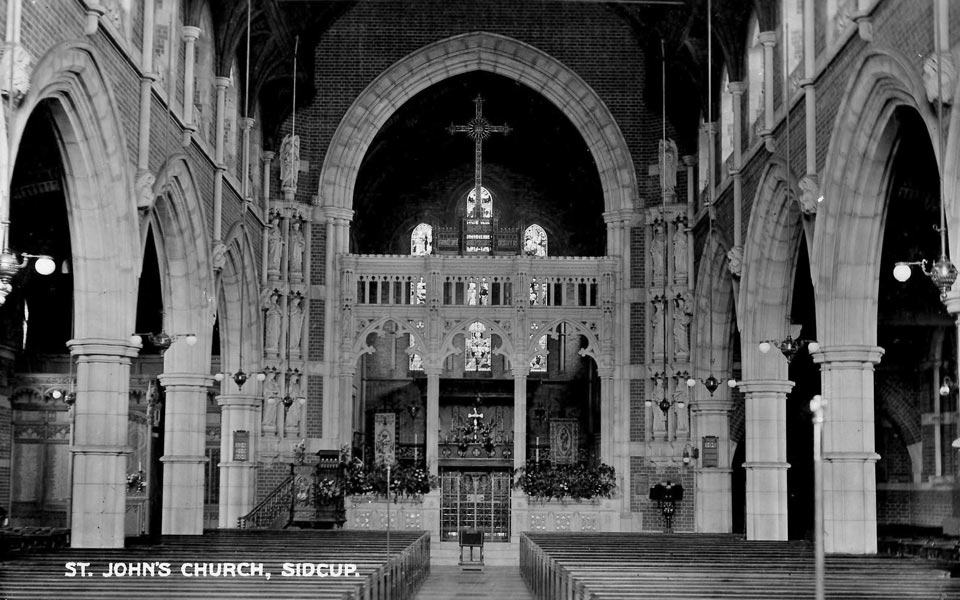
See also St John
Sidcup for an illustration of the “stacked” saints there.
An extract from the local paper follows describing the consecration of the
new church.
Notwithstanding the imposing interior of the new church, its length of
nave, breadth of chancel, height of roof and dignified east end, some regret was
felt by the large congregations which attended the three celebrations of Holy
Communion in the old church at their leaving, for the old church has been
endeared to them by long use. Although they did not confess it they found the
permanent church new and strange. They all agreed, however, in admiring the
altar with its high dossal of white and crimson silk; its tall cross and
candlesticks; its beautifully designed frontal and its hanging sanctuary lamps.
At the luncheon after the service, the Chairman said that they
…had had an architect who had left upon his work the marks of his genius
as an artist and his devotion and knowledge as a Churchman; and the architect’s
design had been executed in brick, stone and wood by a most competent and
conscientious builder, and by faithful, industrious and skilful artisans and
labourers (cheers).
As an aside, it is worth quoting from the report of the Bishop’s reply to
the Chairman’s speech:
The Bishop of London, who had to leave early to keep another engagement,
said it was the unfortunate part of a bishop’s office that he was continually
being reminded that he was a nuisance and was continually being placed in the
position of having to make himself a nuisance. The fact that he had to get away
had made it necessary that they should be disturbed in the enjoyment of their
luncheon by the commencement of the speeches and that their vicar should speak
against the rattle and clatter of knives and forks. This difficulty did not
apply to him in the least degree, for he already had that experience without
which no human being had sunk to the lowest depths of despondency - the
experience of making a speech in the House of Lords - (laughter) - and anybody
who has faced that ordeal could face any other to which a man could be subjected
(laughter).
The health of the architect was proposed. He had given the town
…a church of noble proportions, simply dignified, and effective,
well-lighted, well-warmed, well-ventilated and with excellent acoustic
properties.
Mr Fellowes-Prynne [sic] said oratory was not one of the essential
qualifications of an architect, and he should not trouble them with many words,
but there were one or two things he must say. In the first place, an architect
was very much dependant upon those who worked under him… To deal with another
point: One of the greatest difficulties of architects was the inevitable
Building Committee - (laughter) - but he would assure them that he had never
worked more happily or harmoniously with a committee that he had done in this
case… The clients of church architects varied. Some - and happily they were the
majority - had for their sole end aim the glory of Almighty God; but there were
others who were not contented with whitewashed walls for themselves, but wanted
to bring everybody else down to their whitewash level - (cheers and laughter).
Church architects, if they were worthy of the name, were not ashamed of the
symbol of their religion - (cheers) - and they wanted to build churches in which
the people who entered would see the great symbol and would be led on under that
rood, under the Passion of Jesus, feeling that they must pass under the sorrows
of Christ before they could enjoy the highest blessings of heaven - (cheers). It
was only such feelings which could inspire or help forward the architecture of
the future.
The speaker on behalf of the builders said that the congregation had
…got a beautiful church, and a cheap one - (laughter) - and he hoped they
would all be spared for a long time to worship in it (cheers).
(Middlesex County Times 17 June 1899)
A formidable list of contractors was involved in this building:
- H. H. Martyn (figures & carving)
- Tanner (mosaic, granite & marble)
- J. Jones & Son of Farringdon Street (heating)
- A. Stalman of Portman Square (dossal & altar hangings)
- Laing, Wharton & Down of New Bond Street (electric lighting)
|