| |
Here is one of the most interesting of Fellowes Prynne’s churches. It has a
feeling of balance and poise both inside and out, which is greatly to do with
the fact that it was completed as the architect originally intended.
The ground plan is basically rectangular, with irregularities to accommodate
vestries, the sanctuary and a south transept. There is also a porch and, at the
west end, a tower. The building is similar in concept to Fellowes Prynne’s most
successful “town” churches such as Staines and Roehampton but, located as it is
in the heart of rural Cornwall, it is a little less imposing in scale and colour
than these.
The
exterior is faced in local stone, with Bath stone and granite providing
contrast. The stonework is more random that many other examples, with the use of
large and small blocks. The overall colour is a mixture of yellowish-cream and
light grey, with a natural weathering which succeeds in giving the building a
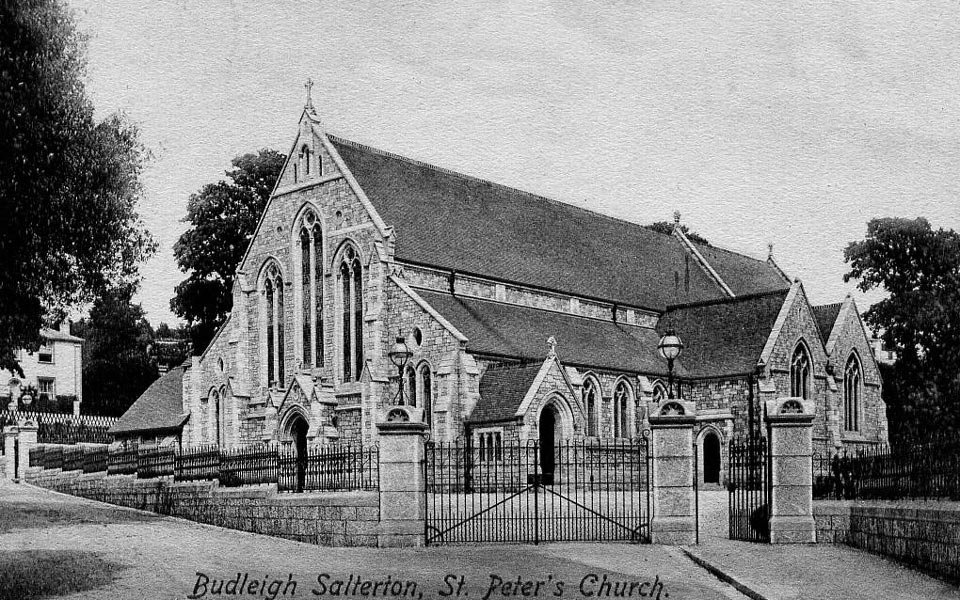
suitably rustic feel. (Compare this with the brickwork of
St. Peter, Staines or the grey
stonework of St. Peter, Budleigh Salterton.) The rustic
theme is furthered by the delightful wood-on-stone porch, with its
decorated gable and simple leaded windows.
The basic construction of this closely resembles Fellowes Prynne's typical
design for a lych gate, such as that at St. Peter, Staines, with the exception
that there is glazing in the woodwork, and the roof details are not on view.
Instead of visible tie beams, the gable end is decorated with carved pierced
woodwork. None other of Prynne’s churches displays this particular feature.
The
tower supports a copper spire, so often seen on original plans, but so rarely
carried out. See St. Peter, Bushey
Heath and St. Peter, Staines
for other examples where the spire IS in situ. See photo of the
exterior.
The interior displays many of the standard features described elsewhere. The
nave has three arches either side, with octagonal pillars. The roof trusses
spring from corbels above the pillars. The roof itself is not Fellowes Prynne’s
usual type of barrel roof, but is open with the trusses and frames visible.
There are no tie-beams either, unlike the larger buildings. There is no chancel
wall; there used to be one, but it was removed in 1988 and reused below the
organ chamber as, according to the guide book, it was not part of Fellowes
Prynne’s original design (which surprised me considerably – and I remain
unconvinced!). There are the usual elaborate oak choir stalls, and coloured
encaustic tiles on the chancel floor. The chancel arch reaches the roof, and is
highlighted by the use of dark grey and cream stone blocks alternately all
around. This banding is also used for the transept arches off the chancel.
The
sanctuary has red, yellow and green tiles in elaborate patterns on the floor,
but its chief treasure is the magnificent altar. This is a classic Fellowes
Prynne altar design, with five panels, a step and a central tabernacle. The five
panels house paintings by Edward Prynne of angels, seraphim, and the Lamb. |