| |
Fellowes Prynne was commissioned to come up with a design after the incumbent
had visited Budleigh Salterton and seen St. Peter’s church. Unlike most of the
parishes for which Fellowes Prynne worked, this was much more a “low church”
than an Anglo-Catholic congregation.
He had designed a rose window for the east end, but was over-ruled by the
parish, and the question arises as to whether anything else he would have wanted
had to be omitted. It is difficult to tell on seeing the building now, as there
have been alterations and modernisations to the chancel and sanctuary.
Overall, the building has a typical lofty red brick and white stone interior,
with the usual barrel roof. The arches are stone faced. There is evidence of a
chancel wall having existed, but this is no longer in situ. There is a carved
altar (covered at the time the church was visited) and a black and white marble
floor in the chancel and sanctuary. The usual parquet flooring is found in the
nave and, unusually, pews rather than chairs (but see comment above). There is a
variety of stained glass, all originally designed by Fellowes Prynne, who also
designed the later War memorial.
The Lady or morning chapel is of particular interest. It is in the favoured
apsidal form, and has not only an altar with a painting by Edward Prynne, but
also a canopy over the altar, depicting Christ in Majesty. The painting on the
altar bears the artist’s monogram. The Lady chapel is otherwise very typical,
with curved sanctuary steps, and turquoise mosaic flooring with scattered white
inlay, and the architect's favoured chairs. Fellowes Prynne had apparently been
asked to modify the design of the chapel by the same people who objected to the
rose window, but he held his ground in this instance.
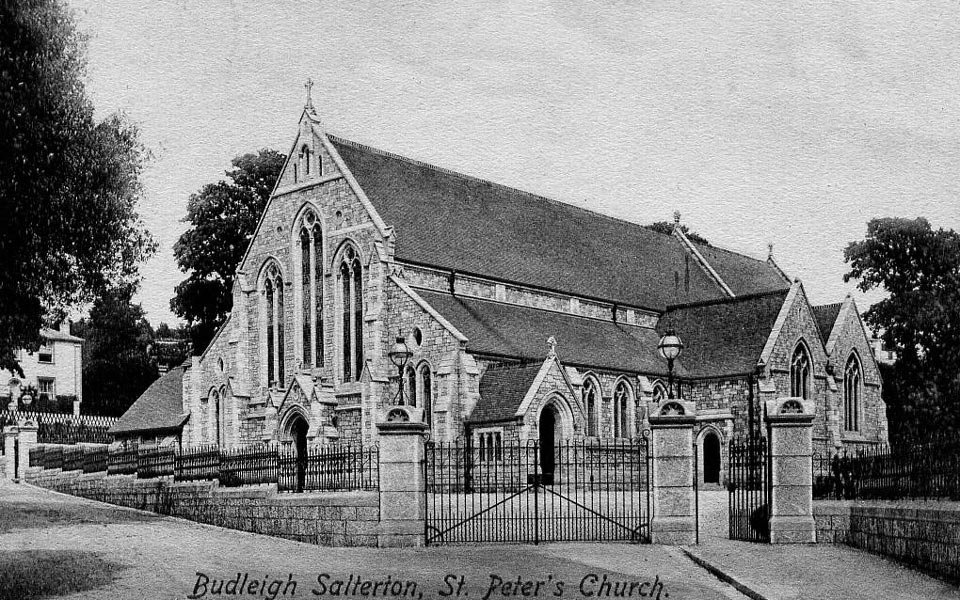
The exterior is of pale sandstone, with sufficient texture and detail to
detract from the potential starkness. A tower was in the original plans, and,
although commenced, was never finished. This would have been the principal
external feature and, as ever, would have given the desired balance and poise to
the complete building.
The building was done by R Wilkins & Sons Limited, and the foundation stone,
laid in the north wall by the Bishop of Bishop of Kingston, bears the date 23
October 1909.
The postcard showing the
interior was never used, but is almost certainly how the church looked at
around the time if its consecration. |