| |
screens
A trademark of George Fellowes Prynne’s work, most notably in the large
churches of the Home Counties, is the massive stone screen, though he also
designed screens in wood, and also metal. Here is an overview of his work.
Stone Screens | Wooden
Screens | Metal Screens
Introduction
 The Essex churches of St Mary the Virgin, Great Bardfield and St Mary the
Virgin Stebbing are usually cited as being influential in Fellowes Prynne’s
development of the stone screen. Both have massive mediaeval screens at the
entrance to the chancel, elaborately decorated and with a central cross. The
example at Stebbing has no figures, either on the cross or beside it, but that
at Great Bardfield has the complete scene of Jesus on the cross, flanked by his
Mother and St John. Both examples are sub divided into three sections, with the
central section being wider than the outer divisions. This
leads to a lancet arch feature either side of the central rood. See the
postcard (left) of Great Bardfield church. Note that the screen does not
spring from a chancel wall, but is based on the floor of the church. The screen
at Stebbing (right) has a chancel wall either side of the pillars,
although it is not known by the author if this feature is contemporary. Fellowes
Prynne’s great stone screens are in general sub-divided into three sections,
which may be equal, or else with the centre slightly wider, giving more scope in
the central arches for rich tracery and decoration. Some contain figures, some
do not even have a rood, but each is an individual work of art and craftsmanship
worthy of attention. Examples of stone screens
Click on the links below to the churches named to read about their particular
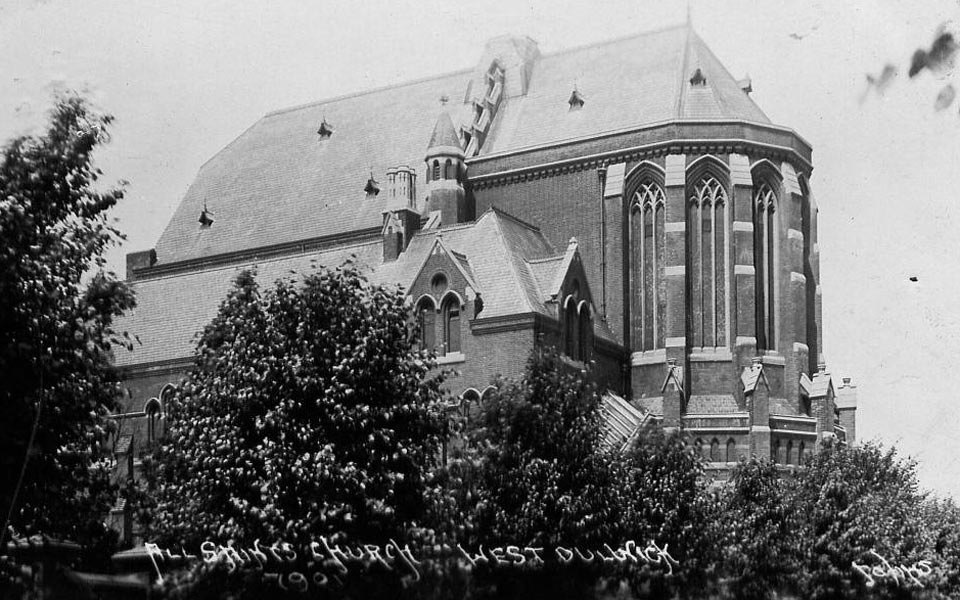
stone screens. All Saints’ West Dulwich |
St. Peter’s, Staines |
St. Nicholas, Taplow |
All Saints Sydenham |
Holy Trinity Church, Roehampton
The screen at All Saints’ West Dulwich, London, now collapsed following a
devastating fire, was the first of George Fellowes Prynne's stone screens. The
screen was a composite, having rich stone tracery filling the expanse of the
chancel arch, and below it, between central shafts and the sides, a set of iron
cross members, the central one of which housed the rood and figures. The tracery
of the stonework centred around three circles. The centre circle was divided
into five segments, and the outer ones into four. Below them were three arches
with cusp features decorating them. The central arch extended higher that the
outer ones to meet the centre circle. The circles and arches were so designed
that the space in the chancel arch was filled to the optimum extent, with very
few ‘gaps’ to infill. The pillars sprung from a chancel wall, very much a
feature integral to the screen, but in almost all cases constructed whether a
screen was built or not. In Dulwich one observed the slenderness of the pillars,
indicating that the nature of the screen was such that all the stresses and
thrusts were borne correctly by the structure of the building and pillars. In
this respect Fellowes Prynne had mastered the engineering competence of his
mediaeval forbears.
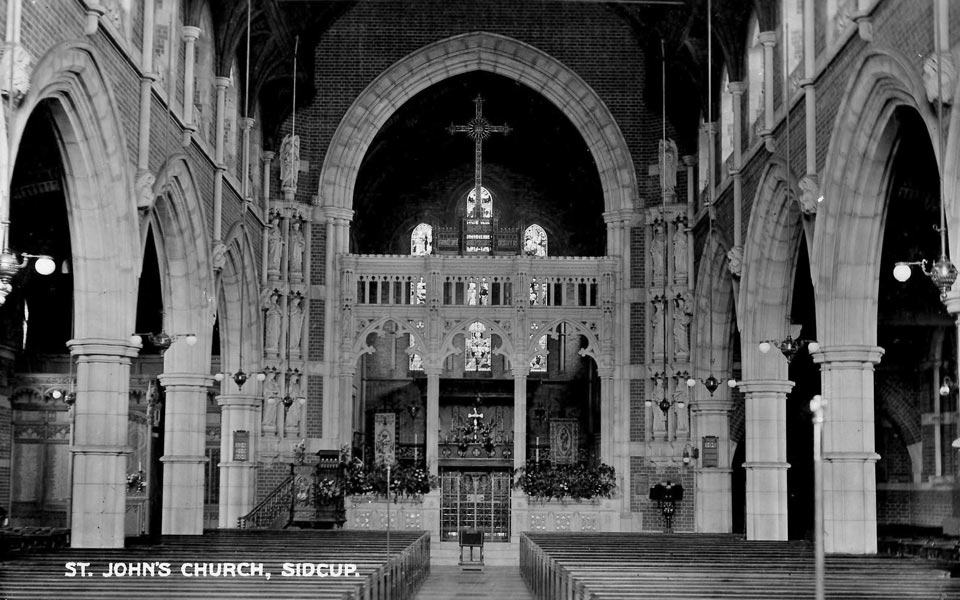
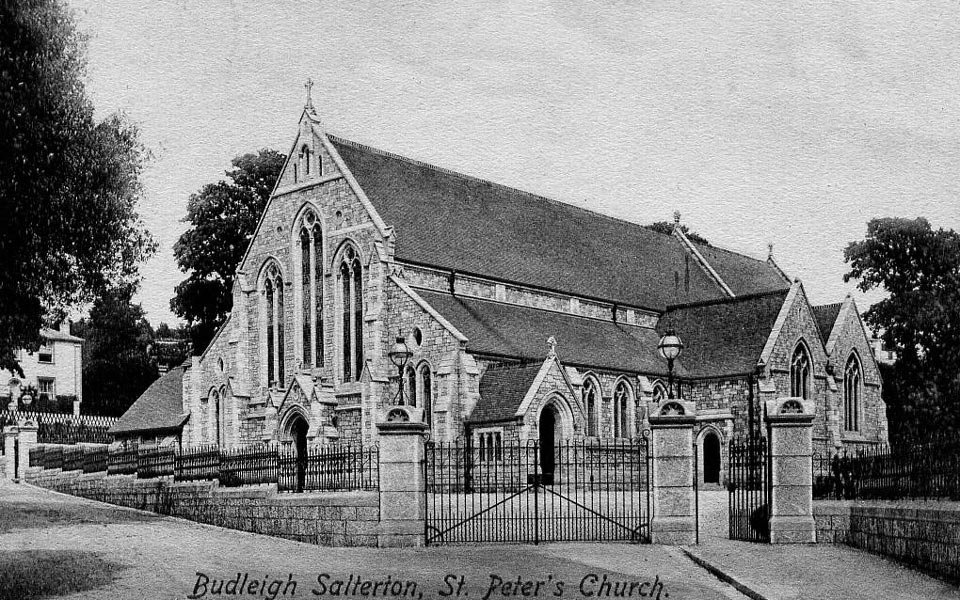
At St. Peter’s church, Staines, Middlesex, Fellowes Prynne designed what is
probably his masterpiece of a stone screen. The Staines screen is divided
into the usual three parts, in this case equal. It springs from a chancel wall,
which itself bears an attractive wrought iron screen. The piers rise to
identical arches with open trefoil tracery. The rood and figures are set on a
level along the tops of these arches, each on a corbel. There are not only the
usual three figures, but two angels on either side of the central figures.
Unusually, the whole of the central unit, rood and tracery together, has been
fashioned from one piece of stone. This can be seen as the architect’s plan by
the way the points of the small arches above St. Mary and St. John merge upwards
through the ends of the horizontal part of the cross to the top of the
structure. As well as the mullion style tracery around the central figure, there
are little bits and pieces of ornamentation filling the remaining spaces, chief
of which is a pair of small circles with trefoils at the extreme sides of the
screen.
The screen at All Saints, Sydenham, London, like
St. Peter's, Staines, has
figures incorporated. Sydenham’s screen has other similarities with that of
Staines in that springs from a stone and wrought iron chancel wall (complete
with fine iron gates), and also in being of three equal sections with similar
arches at the point where the tracery starts. The figures however, each occupy
one complete third of the width (though the outer figures are inevitably
enclosed by the chancel arch), and they stand on a horizontal stone beam. This,
together with distinct vertical divisions, gives this screen a much more
geometric appearance than, say, All Saints West Dulwich or Staines. The tracery
incorporates trefoil and quatrefoil motifs, and is especially elaborate and
thick-textured around the rood.
 At St. Nicholas, Taplow, Bucks the divisions are unequal, with the central
division capped by a higher, more solid arch than those which flank it. The
point of the arch becomes the base for the rood, and either side of this base is
a small horizontal “platform” for the other two figures. To each side can be
seen a circle within the lancet arch which extends upwards from the piers. In
the circles are kneeling angels, and the remaining spaces contain the usual
features of tracery. Unusually, this screen does not rise from a chancel wall,
but is based on the floor, (similarly to that at Great Bardfield – see
introduction to stone screens). There is a wrought iron screen at this level,
however.
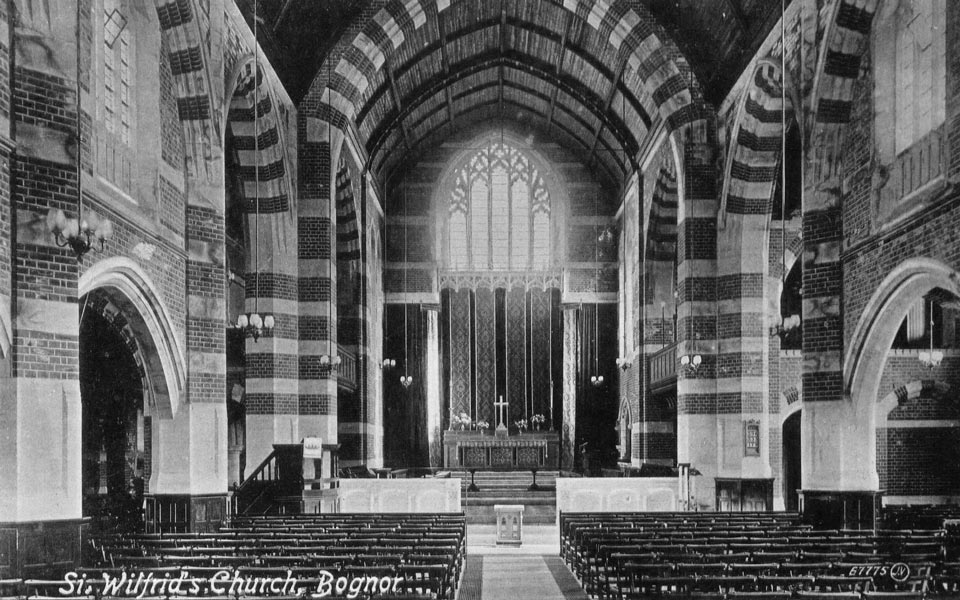
A fine example of a stone screen by Fellowes Prynne can be found at Holy
Trinity Church, Roehampton, Surrey. This is again different, both in style and
content, from the other stone screens described. Rather than no figures at all,
or the usual trio of figures in a rood group, there is simply an angel holding a
scroll. There is a wrought iron cross, and decorations to the sides rather
similar to those which were at All Saint West Dulwich, but no cross in the
stonework. The three sections are almost equal in breadth. The only indication
that the segments are unequal can be seen by comparing the distances between the
fleur-de-lis motifs at the cusps of the tracery in the central arch and its two
neighbours. The small discrepancy allows the designer to extend right to the top
of the chancel arch the secondary arch structure in which the figure is housed.
There are these secondary arches on either side also, but these simply contain a
large encircled trefoil. There are smaller circles in the spaces between the
secondary arches, and small cusps to make interesting the remaining spaces.
Introduction
George Fellowes Prynne, being a West Countryman, was well acquainted with the
ancient wooden rood screens of the village churches of Devon and Cornwall. He
was often called upon to restore such artefacts, and in a number of cases, to
replace them where they had been disposed of by a previous generation, or fallen
into decay. Of the complete, new wooden screens designed by Fellowes Prynne,
five are to be found in the west of England. The best example of his work
restoring a screen is also to be found in the West Country. Away from the West
Country, there are four examples of wooden screens newly designed by Fellowes
Prynne. These are at Henley-on-Thames, Oxfordshire, at
St. Bartholomew’s Hyde,
Winchester, at Wargrave, Berkshire, and at
Rattlesden in Suffolk. Examples
Click on the links below to the churches named to read about their particular
wooden screens.
St. Columb Major |
St. Mary, Henley |
St. Bartholomew, Hyde, Winchester |
St. Mary,Wargrave |
St. Nicholas, Rattlesden |
St. Peter, Buckland-in-the-Moor

Card dated June 4 1919, but not postally used
St. Columb Major in Cornwall is typical of Fellowes Prynne's wooden screens
in style and appearance. It is of oak, retaining the rich redness of the natural
wood rather than being stained dark. There are two divisions on either side of
the double doors in the centre. The double doors are treated as one large
division for the purposes of the tracery. The screen has the effect of a chancel
wall at its base, with no “daylight” between the divisions. Instead, there is
decorative foliation around what would in mediaeval times have been a sequence
of paintings. (Compare St. Peter Buckland-in-the-Moor). The mullions
sub-dividing each section are decorated with a spiral motif, and each arch,
formed as the main pillars fan out to support the main structure of the screen,
is filled with ornate tracery. Above there are layers of stylised carving,
including the Latin text: PER CRUCEM ET PASSIONEM TUAM PER PRETIOSEM MORTEM
LIBERA NOS DOMINE
(By thy cross and passion and precious death deliver us Lord) Both above and
below these layers can be seen delicate patterns giving the finishing touch to
this part of the screen. The rood and figures are placed on top of the screen to
which there is access via a stairway and door in the north wall. The screen,
though not the rood group, was carved by H. H. Martyn and Co. of Cheltenham, who
also did similar work for Fellowes Prynne at St. Cleer and St. Neot; some ladies
of the parish carved the rood group. Further examples of west country churches
with wooden screens by Fellowes Prynne are at Poundstock and South Tawton.
At St. Mary, Henley, the screen follows the basic pattern of those in
Cornwall. There are however some differences when compared with
St. Columb
Major, for example. First of all the lower part of the screen, where the chancel
wall would otherwise be, is not solid but has attractive filigree carving in
panels across it. The mullions, dividing each side into two units do not become
fan shaped at the top, and furthermore there is no sub-division of the lights of
the screen. The in-filling tracery at the tops of the lights is much more freely
structured than if it were dependent on sub-dividing mullions: the effect is of
an arch shape made by the filigree work, as opposed to by the structure. It is
an effective variant on the mediaeval concept. The horizontal carving is both
luxuriant and at the same time delicate. The bands are much thicker than those
at St. Columb Major, giving the structure considerable presence in a large
building. The figures are located at the top of the screen in the traditional
way, on a podium decorated in a manner complementary to the rest of the screen.
The design includes memorial panel and clergy stall. The screen is
particularly fine in the delicate design and detail of the tracery, and
although substantial in size, it is designed so that the view to the
sanctuary is not impeded.
The craft work was carried out by Messrs. Dart and Francis at a cost
to the parish of nearly £1000.
 Hyde is very much a village within the City of Winchester, and like many
villages, it has an historic church. George Fellowes Prynne’s contribution to
its legacy is his splendid oak rood screen, presented in 1908. It is more
similar in appearance to St. Columb Major than to
Henley, and has a text as at
St. Columb Major, but the English version rather than the Latin. The tracery is
considerably heavier in appearance than either of the two already described.
Features of the carving and tracery are picked out in gilding, to give glorious
opulence to the whole structure (see illustration).
Furthermore the rood and figures of this screen are especially magnificent, with
the scene depicted on either side of the podium on which the rood stands. One
side shows two angels kneeling, with the chalice and host depicted above the IHS
symbol for Christ’s name. On the east facing side, effectively the back of the
screen, the detail is no less exquisite, with kneeling angels bearing a shield
depicting the lamb and flag emblem. It should be noted that the text and gilding
are executed to equal effect on the east-facing side of the screen as on the
west.
St. Mary, Wargrave was almost completely destroyed by fire, and it fell to
Fellowes Prynne to design the rebuild. The job was completed in 1916, and one of
the design features he used was a wooden screen. Pictures of the church before
the fire show that here was no screen, though this does not of course mean that
there never was one. There is an attractive simplicity about the new screen. The
principal feature is the overhanging carved “pelmet”, which, if it were not so
beautiful, one would be tempted to compare with the best Great Western Railway
platform awning! It is this canopy effect that makes it so different, and, as it
does not house a rood or figures, so very effective. There is a remarkable
amount of “daylight” to be seen through the structure, despite its depth at the
top. It is surmounted by a pattern so delicate that it is a tribute not only to
the designer, but to the deft craftsmen, who too often fail to be given the
credit they so deserve. In this case, it was the firm of A. Robinson of London
SW1.
 St Nicholas, Rattlesden in Suffolk has what must be Fellowes Prynne's most
important wooden screen. It is of oak, and is the complete assemblage of screen,
Rood loft and Rood group. The base of the screen echoes a mediaeval fragment
seen elsewhere in the church, and it contains carvings of the instruments of the
Passion, as well as the “IHS” symbol for Christ's name, and the XP monogram.
The most unusual feature of the whole piece is the access to the original
staircase linking the top of the parclose screen (at the side of the Lady
chapel) to the Rood loft. The top of the main screen, therefore, is accessible.
The photograph shows the part of the parclose screen which houses the landing
for the wooden and stone steps leading up to the main screen (which can be made
out at the top left of the picture). This is a wonderful and unique piece of
restoration; what a tragedy it would have been to leave the mediaeval steps in
“mid-air” rather than, literally, restore them to their intended usage, as
Fellowes Prynne had the foresight and insight to do.
The postcard illustrated is undated and unused, but
gives a particularly good view of how the light from the East window picks out
the tracery in the Rood screen.
By
far the most important aspect of Fellowes Prynne’s restoration at Buckland is
the work he did with the great screen. The original dates from the
fourteenth century, and it is typical of Devon churches for such a screen to be
present. Whatever one may think of the treatment by Fellowes Prynne of the
reredos, from a historical point of view, one can only be admiring of his
restoration of the screen, for this is exactly what he did. He resisted the
temptation to tear the old one down and start again, though he was well capable
of designing as brand new, fully compatible screen if he had thought fit. (See
St. Nicholas,
Rattlesden.)
Observation
of the screen reveals much of the original fourteenth century carved and painted
wood: the painted panels are located along the base of the screen, but they have
each been framed by newly-placed carved wood, giving a unified wall effect. The
paintings are to be found on the doors of the screen also. The main uprights
are a mixture of original and replacement wood, though the tracery is all
new. The fan vaulting supporting the main “roof” of the screen (which would have
been accessed by a small stairway) is also new. The horizontal decoration, full
of rich carving, is an amazing jigsaw of the old and new. Between new
undecorated parallels can be seen intricate carvings of leaves, fruit and
flowers. Parts of these are in the original painted wood, and parts are new,
carved to exactly the same designs, and carefully placed among the original
pieces to fit together as one. No attempt has been made to “age” the replacement
wood, nor to paint over all of it to make it look the same. Clearly the screen
does not look exactly as it did when first it was built; Prynne has added two
top layers of decoration, as well as the plain horizontal members, which are
possibly as much for structural rigidity as anything. What the screen does look
like is a thing of beauty, in its correct context, which has been painstakingly
saved from oblivion in the hands of a restorer and his craftspeople who patently
cared for it.
Prynne did not give the back of the screen such painstaking treatment - he
completely renewed it. Whether this was on grounds of cost, or because this side
of the screen was beyond repair is not known. He used different patterns from
those on the front, and thus impressed a little more of his own originality on
this magnificent artefact.
The overall impression created by the interior of Buckland church is of an
old church which retains its sense of the past, but with generally suitable and
sensitive repairs and replacement.
Introduction
Wrought ironwork provides the material for a number of screens of different
shapes and sizes. In many cases, the screen is situated on top of a stone
chancel wall, giving added dimension to this feature, whether or not there is an
associated stone screen. Integral to this kind of wrought iron screen is the
pair of gates situated at the entrance to the chancel. There are good examples
at St. Peter, Staines,
St. Alban, Bournemouth,
All Saints, Elland,
St. Peter, Porthleven and
St. Nicolas, Taplow. There are also wrought iron screens
suspended between the piers of stone screens, as can be seen, among other
places, at Holy Trinity, Roehampton. These screens are of fine, airy structure,
and complement the stone screen, the chancel wall and the wrought iron screen on
the chancel wall, all of which are weightier structures. Prynne’s use of
wrought iron for pulpits is highlighted elsewhere in this chapter, but it may be
of interest to quote from parts of an article in The Building & Engineering
Times (of 12 September 1885, page 143) relating to decorative art, in
particular metalwork. A paper was presented to the Conference of the Society of
Architects at Plymouth, on 3rd September 1885, by George Fellowes Prynne. In it
he complained of the over-use of iron in architecture, in particular cast iron,
ornamentation in which he regarded as worthless. He felt that the preponderance
of cast iron work had been anything but a help to the artistic treatment of
iron. On the other hand, he argued, wrought iron gave scope for originality of
design. It lent itself to “….vigorous and strong, beautiful and slender
treatment and to ease and beauty of form quite unobtainable in any other
material.” He goes on to describe how the decorative work of the 13th century
was the most perfect in terms of true simplicity and symbolical design. “The
greatest aim in design was simplicity and beauty of form. Much of the best
forged work was spoiled by being over-elaborate in design. Above all things,
ornament in iron-work should never interfere with the use or suitableness of the
article. As a general rule the leading constructional lines should not be
hidden, for weakness of effect was thereby imparted just where the eye sought
for solidarity and strength. Overcrowded ornament in all work was
unsatisfactory, and never had the charm of light and simple treatment. Iron-work
required as much, if not more, careful study than any other building material,
and he recommended all who took and interest in the subject to study and make
careful sketches of old work. With regard to workmanship, the craftsmen of the
present day were in no way inferior in skill to their ancient brothers of the
hammer, but the great thing that needed to be instilled into them was feeling –
to make them take a true pleasure and pride in their work, and to make their
work as much a labour of love as it was a labour for bread. This was undoubtedly
an age in which there was a great seeking after truth and beauty, and if that
line were consistently followed, bad art and perishable materials would be
doomed.” Example
Keep the lecture referred to in the Introduction to
metal screens in mind as you read about the screen at Christ Church, Epsom
Common, Surrey. It is totally different from anything else of his work seen by
the author. It is made entirely of metal, yet in appearance resembles much more
the style of a wooden screen. It surmounts a stone chancel wall, but in no other
way is it typical, except in its actual design. The Parish magazine for August
1909 described the screen thus: “The screen is of wrought iron and bronze,
with richly ornamented traceried panels. Immediately over the central gate rises
a cross, twelve feet in height, carrying the figure of the Saviour, and
supported on either side by figures of the Blessed Virgin and St. John. There
are also on either side of the cross angels carrying emblems of the Passion. The
whole meaning of the rood, and a very beautiful one, is that only by passing
under the sufferings of the Cross can we reach the holy of holies. Beneath the
cross and in a large plaque are the words: “By Thy Cross and Passion; good Lord
deliver us”, and running along the whole length of the screen are the following
words from the Book of Revelation: “Alleluia! Worthy is the Lamb that was slain
to receive power, and riches, and wisdom, and strength, and honour, and glory,
and blessing. Alleluia!” On one side of the screen is the following memorial
tablet: “To the honour and glory of Almighty God, and in memory of William
Sampson Trotter, late of Horton Manor, this screen is erected by his wife, son
and daughter”. The work has been carried out by Messrs Martyn of Cheltenham.”
This description fails to comment on the overall appearance of the screen seen
from further back in the nave. As has been said, there is the feel of a design
for wood here, rather akin to the famous bridge at Ironbridge, which was
designed along the principles for wooden structures, yet was built to that
design – very successfully – in iron. This is not to doubt that Fellowes Prynne
intended this screen to be metal; he was never one for compromise at any other
time, so there is no reason to suppose that this screen looks any way other than
how he intended. Not only does it have upright “mullions” which are solid and
relatively undecorated, but its horizontal component is solid with small
arch-shaped features and a decorative border, certainly unlike any wrought
ironwork of the designer’s seen elsewhere. To complete the analogy with wooden
structures, the two pairs of angels surmounting the screen to the left and right
of the figures are almost identical in appearance to Fellowes Prynne’s
“standard” angels found in so much of his work. In conclusion, it was Prynne
himself, who said in his lecture of 1897 that “…modern metal screens were, for
the most part, a lamentable failure”. He no doubt was confident that he had
amended this state of affairs. |