| |
There follows a catalogue of all George Fellowes Prynne’s work known by the
author to have been carried out or planned, including work outstanding at his
death. In the case of churches totally or almost totally by him, a fairly
detailed description is usually given. Wherever possible dates, costs and details of craftsmen
are included for interest. Much of the information on contractors was obtained
from a contemporary publication entitled Examples of Modern Architects
devoted to George Fellowes Prynne, which has only been seen by the author in the
Fellowes-Prynne family collection. In some instances, it is only the mention of
locations in the contractors’ advertisements which give any reference to
Fellowes Prynne having worked there. Information also came from records such as
those still existing from the firm of Dart and Francis – which are not a
complete record, and therefore not a full catalogue of the work done by Fellowes
Prynne in collaboration with this firm. Other information was found via the
Internet, and, in a couple of cases, by happy chance! Also included is work by
Edward Prynne wherever information has been acquired in the course of
researching his brother. The author is aware that there are likely to be other
examples of work carried out under George Fellowes Prynne's direction, and would
be pleased to hear of any such examples.
- Buildings designed entirely, or almost entirely, by George Fellowes Prynne
are marked with an asterisk (*).
- Where small photographs are shown, click on the image for a larger
version. (This site especially features photos and postcards from the
early days of the buildings and restorations, but more modern photos will be
added in future.)
- Where a larger amount of text or photographs is available about a
particular church, or details about the church are included on another page on
the site (for example, it has a notable screen), an emboldened link will take you to a new screen.
- Click on the links below to jump to town names beginning with these
letters:
ARMAGH Co. Armagh
The Cathedral Church of St. Patrick
_small.jpg)
The reredos at St Patrick, Co. Armagh. Photograph reproduced by kind
permission of Simon Knott from his excellent website
www.simonknott.co.uk. You can
also
click here to see his work on Irish cathedrals, including this one.
-
Reredos 1913
-
The panel was executed by Percy Bacon Bros., London, and the screen by H. H.
Martyn and sons, Cheltenham.
-
Grant approved for reseating and repairs to roof and floors 1924.
-
Was this done?
-
This was at the planning stage at Fellowes Prynne’s death.
-
The altar rails in the Lady chapel are to Fellowes Prynne’s design.
-
The firm who completed the work was Sydney Tatchell & Co., who kept Fellowes
Prynne’s business ticking over after his death but, by their own admission,
had no feeling for his style, and in the end chose not to take the business on
permanently.
-
Seat fronts, choir & stalls 1919-20 made by Dart and Francis of Crediton.
-
Observation would seem to indicate pulpit also.
In 1927 Fellowes Prynne was the architect chosen to design a new dual purpose
hall (rather than expanding Holy Trinity Parish Church) to cater for the
increase in population in the area following the building of the Castelnau
Estate. However, he died later that year before taking up the appointment, and
Clifton Davey designed the building. (From
www.ecclsoc.org.)
-
Choir vestry 1904.
-
Church now demolished. This is probably the “Pilton Church” Fellowes Prynne
referred to in his notes.
-
Screen completed 1919
-
War Memorial Tablet 1919
-
Also “seat fronts in chancel”
-
All made by Dart and Francis of Crediton
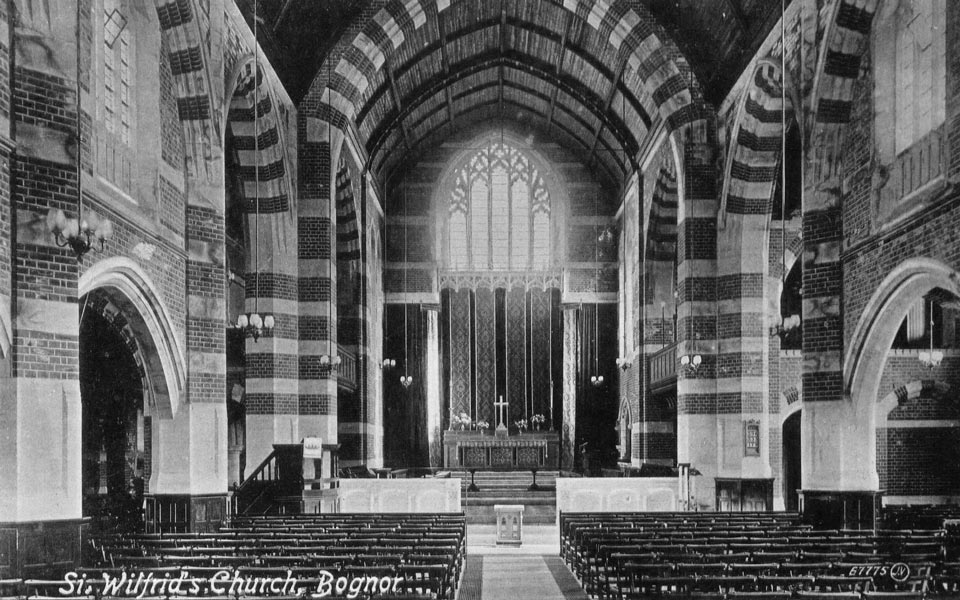
- Pevsner quotes that arches were by Fellowes Prynne. If so, they were
unlike any others of his. The pillars were of red sandstone, and the arches
had three layers. The outside facing was of white stone, then behind it was a
layer of red brick, and then a layer of alternate red and white bricks in
blocks. Whilst the red/white block design is found elsewhere, it was the extra
layer of red brick which was unusual, especially juxtaposed with red sandstone
pillars.
- Screen 1911, and other fixtures and fittings, none of which survived.
- The church was declared redundant, and demolished in 1994.
-
Heating installed by Kinnell & Co., who advertised in a magazine devoted to the
work of Fellowes Prynne published in 1909.
-
Apart from this reference there no further information has been unearthed to
pursue the implied connection with Fellowes Prynne. Does anyone have any
information?
-
Parish Hall “planned” as at 30 June 1927, but seemingly never begun.
-
East window by Edward Prynne
-
Chancel restored after a fire in 1923 (according to Pevsner).
-
Bombed 1940
-
Redundant 1975.

-
Repairs planned as at 30 June 1927, but not begun.
-
No idea which of at least 6 churches this refers to – can anyone help?
-
Altar - clearly by Fellowes Prynne, but no date known.
-
Chapel fittings, parclose screen, etc., 1919.
-
Grant approved for new clergy vestry with organ blowing chamber beneath, and
renewal of floors 1910-1912.
-
I have not been here yet – was this work done?
- Grant approved for renewal of roofs, repairs to chancel arch, walls,
paving, etc., to Fellowes Prynne's specifications 1907-8.
- Was this carried out? – I haven't yet visited this church.
-
Grant approved for repairs to roof 1926, to Fellowes Prynne's design
-
Was it carried out?

Reredos 1924, made by the local firm of Dart and Francisback to top
- 1895 - Report on restoration and rebuilding. Carried out in part by S.
Dobell, with Fellowes Prynne as consultant.
- Did anything come of it?
- 1924 Repositioning of a memorial in the cemetery.
- This location is mentioned in Fellowes Prynne’s notes of 1897 as “now in
hand”.
- However, further details remain a mystery – can anyone shed any light?
DEVONPORT Plymouth, Devon
Cathedral
- 1896 – Fellowes Prynne was one of the two architects commissioned to draw
up plans for the rebuilding of Stoke Damerel church to provide a Devonport
Cathedral. A crypt was dedicated in 1911 (probably not to Fellowes Prynne’s
design) but no more was built.
- Fellowes Prynne’s notes of 1897 say “additions done”. I'd love to know
more!
- War memorial tablet 1919
- (Also in this church is found a chancel wall, with wrought iron screen
complete with gates. A wrought iron cross surmounts the centre of the screen.
Both these features bear the hallmark of Fellowes Prynne’s design, although
this attribution has not been confirmed – can anyone help?)
- Update, February 2007: The faculty petition for this screen
has been traced, and the screen was indeed by George Fellowes Prynne, in 1894.
My thanks to Andy Foyle for sourcing this.
EALING London
Town Hall

- The postcard, used in 1938, shows the lavishly carved 1894 pulpit –
echoing the ancient carving of the pew ends.
- As at 30 June 1927 the restoration of tower and bells was “probable”. It
was never carried out.
- Design submitted in 1895, but rejected on the grounds that it was too large
for the site.
back to top
- This Hall was the family residence of the Lopez family. Demolished 1977. The
stone and windows from the chapel are now part of a private dwelling.
- Repairs to tower, 1923-25.
- Grant approved for repairs to roof-tiling, stone dressings and internal
plasterwork, to Fellowes Prynne's plans, 1922-4. Not seen by me – was it carried
out?
- Altar 1910 (no longer there).
- Prynne’s first secular building, built 1895.
- Grant approved for new south doorway, to a design by Fellowes Prynne 1918-19.
- Not seen by me yet – was it done?
- Referred to in advertisement in magazine about Fellowes Prynne published in
1909. Not known what exactly his involvement may have been.
Can anyone shed any light on this one?

- Fellows Prynne’s notes of 1897 say “tower restored”.
- No records tracked down – help would be appreciated!
- It is clear from observation that the lych gate is to Fellowes
Prynne's design; it is virtually identical to his lych gate at Littleham.
- Grant approved for re-roofing, 1917-25. Note also that this church has many
stained glass windows fashioned by Percy Bacon Brothers – Fellowes Prynne's
contractors of choice. Observation suggests that these may be to his design, but
this is as yet unconfirmed – does anyone have any more on this?
- Reredos; panelling on east, north and south walls 1919.
- The work was done, but it is no longer there.
- This is the church in the graveyard of which George and Bertha Fellowes Prynne
are buried.
- As at 30 June 1927 “New church probable”.
It seems that if it was built, it was designed by someone else (probably less
expensively!)
- Lady chapel altar from St. Mary’s Hornsey is now here.
HORNSEY London
St. Mary
- Lady chapel, a twin of Takely (q.v.) - now destroyed.
- See above entry.
HORNSEY London
St. Peter
- As at 30 June 1927 “repairs planned”.
- Church now redundant.
- Pew - one single piece, evidently from elsewhere.
- Altar in Lady chapel probably by Fellowes Prynne, but again a relocation.
- Stations of the Cross and altar panels by Edward Prynne.
ILFRACOMBE Devon
Holy Trinity (Ilfracombe Parish Church)
ILFRACOMBE Devon
St. Peter
back to top
- Fellowes Prynne consultant for job here, but details unconfirmed.
- “Oak Frame” 1919 by Dart and Francis of Crediton – probably for a War Memorial.
- In his notes of 2 April 1897 Fellowes Prynne mentions this church as one he
worked on.
- However, research has so far yielded little information, save to discount Prynne
in various areas of work here. It is worth noting one or two of the other names
involved here, as they add up to something of a treasure trove of great artists.
The church was restored in 1863 by George Edmund Street; he collaborated with
his former pupil William Morris and his Company. Pevsner cites this as their
earliest known collaboration. Windows are by Morris, Edward Burne Jones and Ford
Madox Brown, and at least one of the windows – the south window by the font, in
memory of Mary Anne Harriet Wise, 1899 - was the work of Bacon Brothers. This
suggests that this window could have been designed by Percy Bacon’s long-time
collaborator, George Fellowes Prynne. However, the Cornwall Records Office holds
no mention of the name Prynne at all. Despite this, there is one
incontrovertible fact: the altar panels are the work of Edward Prynne, and were
painted in 1897. The organ chamber is the work of Edmund Sedding, to a design
dated 1906.
- There is no doubt that considerably more research is warranted here, if only
because of the fascinating mixture of contributors to the beautification of this
little building – and I'd love to be able to establish a definite attribution to
George Fellowes Prynne among all these luminaries!
- Restoration 1901-2 (except tower)
- Stations of the Cross by Edward Prynne.
- Lectern and font 1912. The lectern was made by Robinson's of Bloomsbury.
Additions 1913.
- Observation and implication indicate that Fellowes Prynne may have been involved
in the design of the windows, as most of them were executed by Percy Bacon
Brothers. His brother Edward almost certainly painted the altar panels.
- Unusually, given the probable attribution of the altar panel paintings to Edward
Prynne, the stencilled altar itself does not appear to be George Fellowes
Prynne’s work, although it was purchased at around the same time as the rest of
the work done in the sanctuary.
- I would like to be able to confirm this one way or another – does anyone know?
- Click here for
more information about St Barnabas, Linslade
- Implication that Fellowes Prynne worked here as it is mentioned in a
contemporary advertisement in a magazine about him. No details known.
- Nave 1900 - restoration or rebuild ? - I have not yet visited.
back to top

- Design illustrated for this church in The Builder of 7 February 1903, but
nothing was ever built.
- Restoration 1898
- Repairs to tower 1904
- War memorial (date not established – can anyone enlighten me?)
- Fellowes Prynne’s notes speak of his having worked at “Newport” with no further
definition. An assumption has been made that this is the correct Newport, having
ruled out those in South Wales and the Isle of Wight by contact.
- However, no information has been obtained to substantiate any work by Fellowes
Prynne here, so it remains a mystery!
- War memorial and reredos 1919.
- This reredos is exceptional in that it contains relief carving in the
centre, in white stone, with paintings on the outside.
- The paintings are believed to be possibly by the architect’s son,
Harold, who also became an architect. Can anyone give me further
information?
- A letter from Dart and Francis archives speaks of …alterations to
War Memorial Chapel, including reredos. What exactly these were
to be is not stated – again, any help gratefully received.

- Grant approved for enlargement including new south chapel, vestries, porch and
classrooms, 1905-9.
OXFORD Oxfordshire
St. John the Evangelist (Church of the Cowley Fathers)
- Stations of the Cross by Edward Prynne 1921.
back to top
- Altar
- Not seen in situ, but noted at the Council for the Care of Churches that it is
"worth preserving for use elsewhere".
See also below.
PADDINGTON London
St. Michael
- One of the two churches in Paddington commissioned designs for panelling, and
doors to a new chapel. The designs were returned from the contractors as at 7
July 1920, but reference is merely to “Paddington”.
PLYMOUTH Devon
St. Peter*
- Site of the grave of Fellowes Prynne’s parents, Rundle Prynne and Emily
Fellowes.
- Plympton was also the location of the house known as “Meadowview” or “Limestone
Cottage” which was apparently to Fellowes Prynne’s design. It would seem no
longer to exist.
- Grant approved for enlargement, for which Prynne conducted an inspection only,
in 1907.
- In 1895 plans were drawn up for a new rood screen and canopy for the east end of
the church. It would appear these were never carried out.
- According to a contemporary source an oak reredos was made by the firm
of Robinson to Fellowes Prynne’s design. The reredos in the Lady chapel
and surrounding panelling were installed in 1922 as a War memorial. The
woodwork at the entrance to the west tower is of similar style and the
same date. All this work would appear to be to Fellowes Prynne’s design.
ROEHAMPTON Surrey
Gifford House
back to top
SALTASH Cornwall
St. Stephen
SOUTH TAWTON Devon
North Wyke - House
- “The Desire of all Nations” - painting of 1895
- Stations of the Cross
- Both these works are by Edward Prynne.
- “New house” is listed by the architect in his notes of 1897. Nothing has been
traced – was it built, and if so, where?
- Altar 1925
- This was originally made for the chapel at St. Saviour’s, Dartmouth,
but after a change of plan, was used here.
- The total cost, including angels and gilding, was £55.
- Screen; rood; sanctuary panelling; altar and choir stalls 1910
- Also Lady chapel.
- Organ case 1894-5
- This church has been demolished having been bombed in 1943.
- Repairs planned 1924. However, it seems nothing had been done by Fellowes
Prynne’s death – can anyone enlighten me?
TUNBRIDGE WELLS Kent
St. Barnabas

- His regular heating engineers did a contract for Fellowes Prynne here. No other
work by him has yet been identified – any light on this would be appreciated!
- 1927 – only partially built to Fellowes Prynne's design.
- This was mentioned in Fellowes Prynne’s notes of 1897, but added later under
“restorations etc.”. The parish and the county records are unaware of work by
him.
- Blomfield did major restoration in the 1870s. Records do however indicate that a
little restoration was done “anonymously” to the south arcade 1896-8.
- This is another one I'd like to establish for certain.

- In 1897 Fellowes Prynne produced a “design for St. Andrew’s Hospital for the
Incurables.” This would appear to be as far as it got.
back to top |